
Last Updated: November 4, 2026
Quick Summary
Neither a treat pouch nor a treat ball wins outright for training treat delivery, because each solves a different problem. A pouch gives the fastest, cleanest access for recall, puppy classes and clicker work, while a treat ball suits scent work and calm enrichment. Many owners therefore keep both.
- A clip-on pouch is fastest for under about thirty single rewards per session.
- Rewards should arrive within a second or two for recall training, which a ball cannot do.
- Treat size should be no larger than a pea for repeated rewards.
- Empty and wipe the pouch after every session, then dry it fully before the next walk.
- The treat ball is designed and manufactured in the UK and described as hard-wearing.
Table of Contents
- Treat Pouch vs Treat Ball: Which Training Treat Delivery Method Wins?
- Quick Comparison: Pouches, Balls and Loose Treats
- What Makes a High-Value Training Treat Worth Carrying
- Choosing the Best Dog Treat Pouch for Fast, Clean Rewards
- Dog Treat Dispenser for Training: When a Ball Beats a Pouch
- Why an Easy-Clean Dog Treat Pouch Matters in Wet Weather
- Eco-Friendly Dog Training Accessories That Last
- Portion Control, Treat Size and Food Motivation
- Puppies vs Adult Dogs: Matching Delivery to Development
- Build Your Training Kit at R&J Pet Co.
- Frequently Asked Questions
Treat Pouch vs Treat Ball: Which Training Treat Delivery Method Wins?
Training treat delivery is the part of reward-based training most owners never think about, yet it decides how fast a dog learns and how clean your coat stays. At R&J Pet Co., we sell treat balls, and owners often ask which kind of training treat delivery works better. The honest answer is that neither wins outright. Each solves a different problem.
Below, we break down the three main delivery methods, explain what makes a treat worth carrying, and show you exactly when a ball beats a pouch. By the end, you will know which kit suits your dog, your training goals and your weather.
Quick Comparison: Pouches, Balls and Loose Treats
The best delivery method depends on speed, cleanliness and the type of training you are doing. A pouch gives instant access for lure-based training and clicker work. A ball suits scent-driven problem solving and keeps a dog busy between sessions. Loose treats in a pocket are the fallback nobody recommends once the weather turns.
| Method | Speed of Reward | Cleanliness | Best For | Main Drawback |
|---|---|---|---|---|
| Treat pouch | Fastest | High, sealed and wipeable | Recall training, puppy classes, clicker work | Needs clipping and emptying |
| Treat ball | Slow, dog works for it | High, fully enclosed | Calm enrichment, scent work, alone time | Not for rapid-fire rewards |
| Loose in pocket | Moderate | Low, crumbs and grease | Short ad-hoc sessions | Messy and unhygienic |
What Makes a High-Value Training Treat Worth Carrying
A high-value training treat is one your dog will work for when distractions are high. Value comes from aroma, protein content and texture, not from size. Small, strong-smelling pieces beat a handful of bland biscuits every time.
We look for four things before a treat earns a place in our range. Protein should lead the ingredient list. Pieces should be small enough to swallow quickly, so the dog returns to you rather than chewing. Aroma should be noticeable to the dog without being overpowering to you. And the treat should break cleanly so you can adjust reward size on the spot.
The venison training treats in our range are made from 100% venison meat, naturally air-dried and sliced into small cubes, with a protein level of 38.5%.

Natural Ingredients, Protein and Grain-Free Options
Natural ingredients matter most for dogs with sensitive digestion. Preservative-free, grain-free treats are a sensible choice for dogs with sensitive digestion.
If you want to understand the wider case for natural treats before choosing, our guide on whether natural dog treats are better for your dog covers sourcing, labelling and what to look for. The short version: fewer ingredients, clearer sourcing and no artificial colours or flavours.
Fish-based treats, such as our Cornish fish cubes made from 100% white fish skins, are naturally low in fat.
Choosing the Best Dog Treat Pouch for Fast, Clean Rewards
The best dog treat pouch is one you can open with one hand, clip securely to a belt or waistband, and wipe clean in seconds. Anything slower than that interrupts your timing, and timing is what teaches a dog.
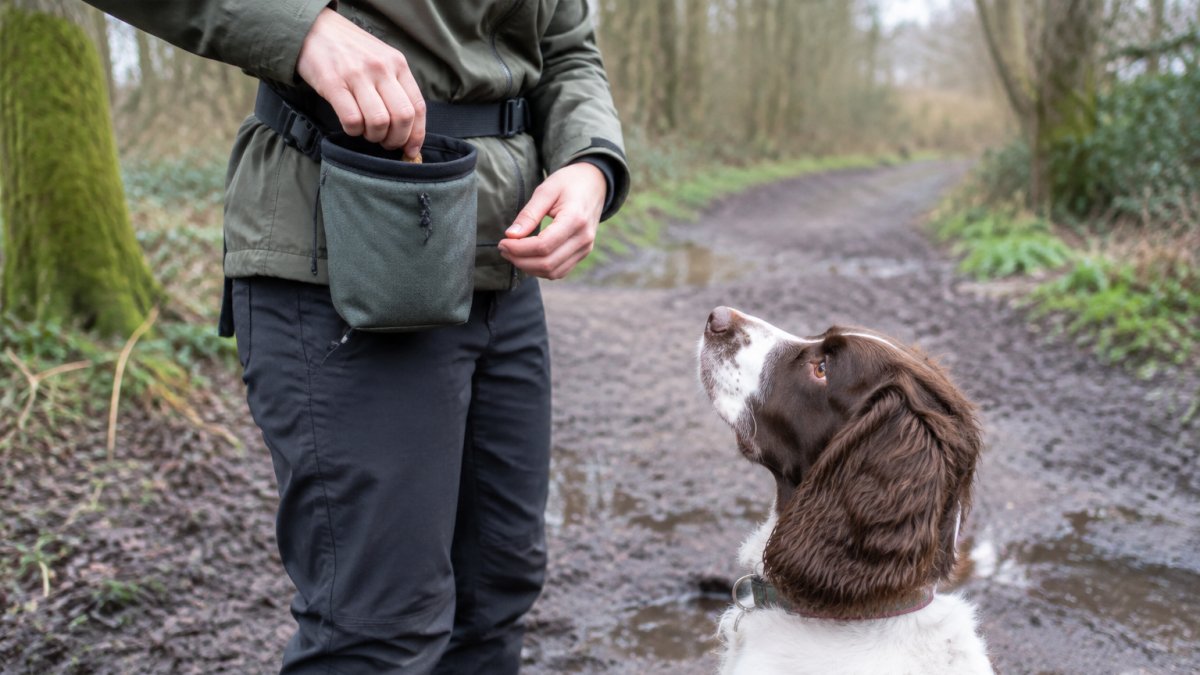
Look for these features when comparing pouches:
- One-handed opening: magnetic or wide-mouth closures keep your other hand free for a lead. Test the closure with a gloved hand, because a magnetic flap that snaps shut easily in the shop can resist a cold, wet thumb on a January walk.
- Wipeable lining: soft and chewy treats can leave residue, so a smooth inner surface makes cleaning easier.
- Secure belt clip: a pouch that swings or falls off breaks your flow. A wide metal clip or a belt loop plus a secondary strap keeps the pouch steady when you jog backwards to reward a recall.
- Separate compartments: useful for mixing two reward levels in one session, so you can reach for a high-value piece for a hard cue without rummaging.
- Water-resistant outer fabric: essential for British weather. A coated polyester or waxed cotton outer sheds drizzle; an untreated canvas outer soaks through and wicks moisture into the lining.
- Depth and mouth width: a pouch that is too deep forces you to fish around, and one with a narrow mouth slows every reach. A shallow, wide-mouthed design lets your fingers find a treat without looking down, which keeps your eyes on the dog.
What most guides miss is that pouch size should match session length. An oversized pouch encourages you to overfill it, which means stale treats and a heavier belt. A small pouch refilled between sessions keeps treats fresh and keeps the weight down on long walks.
Watch out: a clip that grips a thin waistband well can slip off a padded coat belt, so check the clip against the clothing you actually train in before you commit.
Pouches, Belt Bags and Rapid-Dispense Bags Compared
Delivery kit falls into three practical shapes, and each suits a different kind of session.
A traditional clip-on pouch sits at hip height and gives the fastest single-treat access. It is the right choice for clicker work, puppy classes and recall training where you reward one piece at a time.
A belt bag or hip pouch spreads weight across the waist and holds more, which suits longer sessions and mixed reward levels.
A rapid-dispense bag or treat dispenser pouch uses a wide mouth or a gravity-fed design so you can grab several pieces in one motion.
A simple way to choose is to count how many rewards you expect in a session. Under about thirty single rewards, a clip-on pouch is fastest. Over that, or where you need two reward values, a belt bag earns its place.
Matching the Pouch to the Treat
The pouch and the treat have to work together. Hard, crumbly treats break down in a deep pouch and leave dust that clogs the lining, while soft, sticky treats smear the inside and slow every reach. If you use air-dried meat cubes, a shallow pouch with a smooth lining keeps them intact and easy to grab. If you use soft training paste or chewy pieces, a pouch with a removable, wipeable insert saves you from scrubbing seams.
A common pattern is to keep one pouch for dry, high-value rewards and a second for everyday lower-value pieces, so you are not mixing textures and aromas in one bag. That also lets one pouch dry while the other is in use, which matters in wet weather.
Dog Treat Dispenser for Training: When a Ball Beats a Pouch
A dog treat dispenser for training wins when you need the dog to work independently rather than take rapid rewards from your hand. The treat ball is the clearest example: it has a hollow centre for treats or a chew stick and a moulded texture that stimulates the dog's senses as it rolls.

Use a ball instead of a pouch in three situations. First, when you want to build natural foraging behaviour and reduce frustration in a dog left alone. Second, when you are training scent intensity and problem solving rather than obedience cues. Third, when you need to settle a dog after a walk without another food-heavy session.
Watch out: a ball is not a substitute for reward timing. If you are teaching recall, the reward must arrive within a second or two, and a ball cannot do that. Keep the pouch for cues and the ball for enrichment.
Why an Easy-Clean Dog Treat Pouch Matters in Wet Weather
An easy-clean dog treat pouch is not a luxury in this climate. Soft and chewy treats turn sticky in damp air, and a fabric pouch that absorbs moisture becomes a breeding ground for bacteria within days.
Here is how we would keep a pouch hygienic through autumn and winter:
- Empty the pouch after every session rather than leaving leftovers inside
- Wipe the lining with a warm damp cloth and mild soap
- Turn it inside out to dry fully before the next walk
- Rotate between two pouches so one is always dry
- Check seams monthly for trapped crumbs
The practical payoff is bigger than hygiene. A clean pouch releases treats smoothly, which keeps your reward delivery fast and your dog's attention on you.
Eco-Friendly Dog Training Accessories That Last
Eco-friendly dog training accessories should be judged on lifespan, not on the word "green" on the label. A durable pouch that lasts three years beats a compostable one that splits after a month. The most sustainable training accessory is the one you do not have to replace, and that test is far more useful than any marketing claim.
We prioritise British craftsmanship and environmentally responsible European sourcing for exactly this reason. Our treat ball is designed and manufactured in the UK, and is described as hard-wearing.
Packaging counts too. Our Tuna & Crab training treats come in a resealable 70g pouch made from 100% recyclable materials. When you are buying repeatedly, that adds up, and a resealable pouch that actually reseals keeps treats from going stale and being thrown away.
Environmental Durability: Crumbling, Melting and Wet Weather
Most guides ignore the physical behaviour of treats in the real world, and that is where a training kit quietly fails.
Crumbling. Dry, brittle treats break down under the pressure of a pocket or a full pouch. The result is a bag of dust, a slow reach and a dog that loses interest while you fumble.
Melting and greasiness. Soft, high-fat treats turn greasy in warm weather and in a pocket warmed by body heat. That grease soaks into fabric, attracts dirt and turns rancid.
Wet weather. Damp air softens chewy treats and makes them sticky, which slows every reach and encourages bacterial growth in the pouch.
What 'Durable' Actually Means for Training Kit
Durability in training kit comes down to a few concrete checks. On a pouch, look at the stitching at the clip attachment, because that is where a bag fails first under the weight of a full load. Check that the lining is sealed rather than stitched, so crumbs cannot lodge in seams. On a treat ball, check that the opening mechanism is moulded rather than glued, and that the material flexes without cracking when a dog chews it.
A common pattern is that cheaper kit fails at the joints and closures rather than the main body, so those are the parts worth inspecting before you buy. Kit that passes those checks tends to outlast its cheaper rivals by several seasons, which is the practical meaning of eco-friendly.
Portion Control, Treat Size and Food Motivation
Portion control is where most training plans quietly fall apart. A dog taking 60 small rewards in a session is eating a real share of its daily calories, and owners rarely adjust meals to match.
Treat size should be no larger than a pea for repeated rewards. The tuna and crab rewards are ultra-low in fat at 1.35%.
Food motivation varies enormously between dogs, and delivery should adapt:
- Highly food-motivated dogs: use lower-value everyday treats for easy cues and save the strong-smelling rewards for hard tasks
- Moderately motivated dogs: match reward level to difficulty, and use scent intensity to hold attention
- Non-food-motivated dogs: try a treat ball or a toy-based reward, and test palatability with a small sample before buying a full pack
A simple preference test tells you more than any label. Offer two or three different proteins side by side and note which one the dog takes first and finishes fastest. That is your high-value reward.
Puppies vs Adult Dogs: Matching Delivery to Development
Puppies need smaller, softer rewards delivered more often than adult dogs. Their mouths are small, their attention spans are short, and their digestion is more sensitive, so treat size and texture matter as much as the delivery method.
For puppy development, we would start with a pouch and pea-sized soft treats. Keep sessions to a few minutes and reward every correct response. Our puppy training treats with lamb and yellow split pea are sized for this kind of frequent, gentle reinforcement.

Adult dogs can handle firmer textures, larger reward intervals and more complex delivery. A ball becomes genuinely useful here, particularly for dogs that need mental work rather than more food. Senior dogs sit somewhere in between: keep rewards small and low in fat, and favour softer textures.
Build Your Training Kit at R&J Pet Co.
Building a training kit is simpler than the shelves suggest. You need one fast delivery method, one slow enrichment method, and a treat that works for both. Start with a pouch for cues, add a ball for independent work, and choose a protein your dog actually values.
At R&J Pet Co., we stock natural dog treats made with clear sourcing and no artificial additives, alongside durable British-made accessories.
Frequently Asked Questions
What is the safest way to carry treats during dog training?
Use a purpose-made pouch that clips to your belt or shoulder strap so both hands stay free and treats sit away from your face and pockets. Keep strong-smelling items such as fish cubes in a resealable pouch, like the 70g recyclable bag the Tuna & Crab Rewards come in, so aroma does not transfer to clothing. Avoid loose treats in a coat pocket where they crumble and mix with keys or coins, and empty and wipe the pouch after every session to stop bacteria building up.
Are treat pouches better than treat-dispensing toys for training?
They solve different problems. A pouch gives you instant access for lure-based training, recall and clicker work, where the reward must arrive within a second or two. A treat ball suits calm enrichment, scent work and teaching a dog to settle, because the dog works for the food rather than receiving it directly. Many owners use both: the pouch for active commands, the ball for downtime. The R&J Treat Ball at £4.99 fits most standard ball throwers and has a hollow centre for tucking treats or a chew stick.
How do I keep training treats fresh and hygienic between sessions?
Buy in sizes you will use within a few weeks, reseal the bag properly and store air-dried treats somewhere cool and dry. Wash soft pouches inside out in warm soapy water weekly, and dry them fully before refilling. Never mix a new batch into a pouch holding old treats, as the older ones stay at the bottom and go stale.
Can cats use treat-dispensing products for training?
Yes, with adjustments. Cats respond well to small, highly aromatic rewards and short sessions of two to three minutes. A treat ball works for food-motivated cats if it is easy to roll and the openings release treats readily; watch the size of the pieces so nothing becomes a choking hazard. For direct reward training, a small pouch on a waistband keeps your hands free. Choose single-ingredient, grain-free treats where possible and count them within the daily allowance rather than adding them on top.
How do I deliver treats quickly without distracting my dog?
Keep the pouch on your hip on the same side every session, practise the reach without your dog present, and pre-break treats into reward-sized pieces so you are not fumbling. Deliver the treat where you want the dog's attention to end up, not where it started. For recall, reward at your feet rather than in front of your face. Rotate two or three reward levels, such as Poultry Training Treats for everyday repetitions and Tuna & Crab Rewards for recall, so the higher-value reward stays exciting.
Your dog's training progress depends on timing, reward value and consistency, and the right delivery method makes all three easier to manage. R&J Pet Co. can help you get there with high-value training treats, a hard-wearing British-made treat ball, and accessories built to survive real walks. Get started with R&J Pet Co. and give your dog rewards worth working for.
